
Entering the first half of 2026, Asia's carbon credit markets and Emission Trading Systems (ETS) are no longer just "encouraged" or "voluntary" concepts. Dual pressures from international regulations - most notably the EU’s Carbon Border Adjustment Mechanism (CBAM) entering its mandatory compliance phase on January 1, 2026, alongside the newly updated Nationally Determined Contributions (NDC 3.0), have transformed carbon management into a core economic tool that dictates the competitiveness of every enterprise in the region.
The Landscape of the Mandatory Race Among Asian Giants
The structural framework of carbon markets across Asia’s major economies is visibly diversifying and tightening regulations:
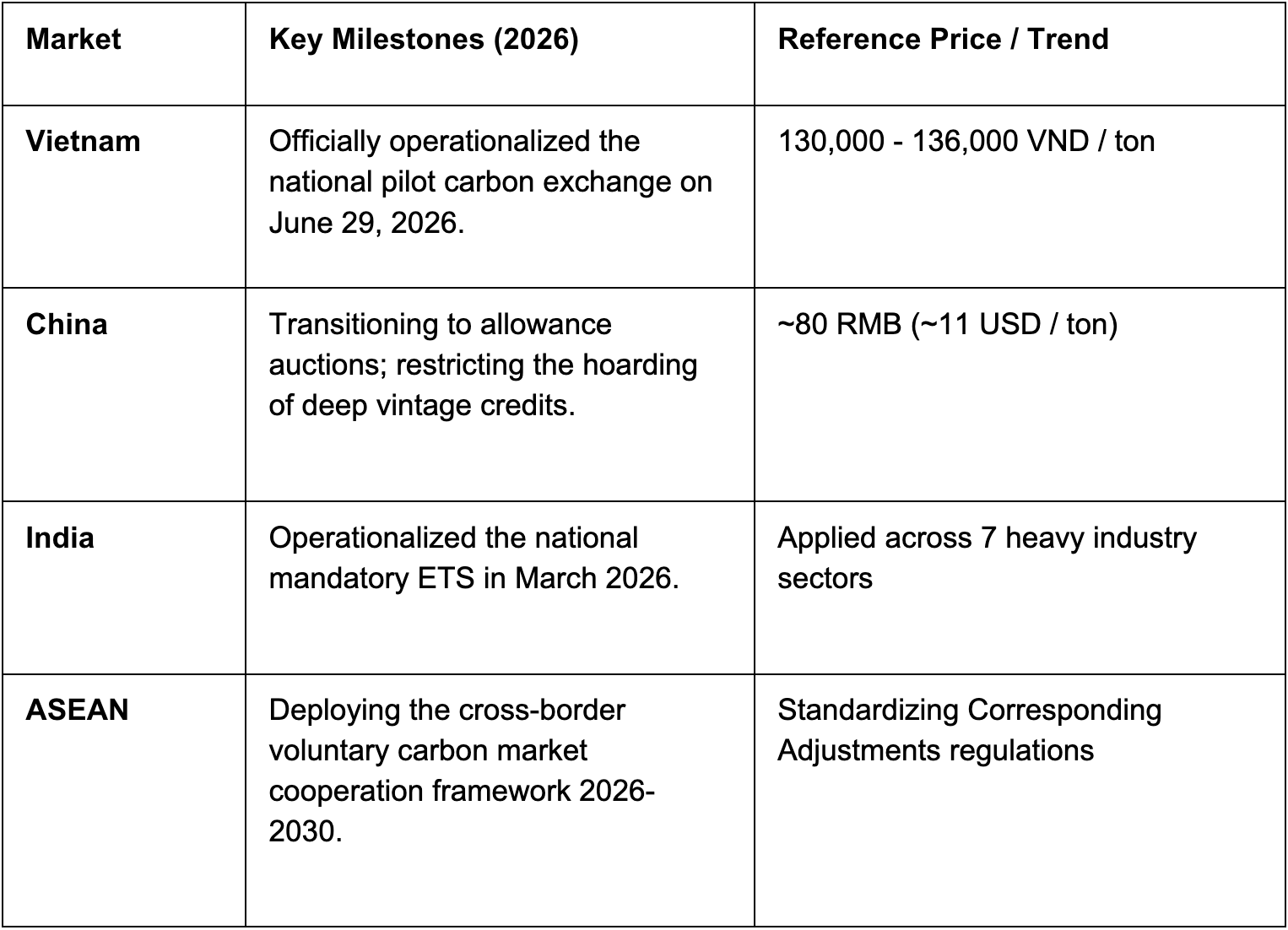
- China (The world's largest market by covered emissions): According to China Briefing, in early 2026, the Chinese Carbon Emission Allowance (CEA) price stabilized at around 80 RMB/ton (~11 USD). The core development this year is China’s transition toward allowance auctions (expected to account for 3% of total allowances this year) instead of fully free allocations, while strictly enforcing rules that prohibit the over-hoarding of deep vintage credits.
- Japan & India: The year 2026 marks a milestone as both nations officially operationalize their mandatory national ETS. According to ICAP, India launched its centralized carbon trading platform in March 2026, immediately applying it to nearly 500 large-scale industrial entities within energy-intensive sectors.
Southeast Asia Accelerates: Vietnam Operates Pilot Carbon Exchange from June 29
The ASEAN region is actively reshaping its position through the ASEAN Voluntary Carbon Market Development Plan 2026–2030. Within this context, Vietnam has just recorded a historic milestone:
New Milestone: On June 29, 2026, Vietnam officially launched its pilot domestic carbon trading platform, recording the first greenhouse gas emission allowance transactions with starting prices ranging from 130,000 to 136.000 VND/tCO2e.
During this pilot phase, enterprises may offset up to 30% of their emission quotas with carbon credits. For international transactions, Vietnam proposes to retain 50% of the total credits generated to serve national climate goals before any overseas transfers. Furthermore, Vietnam’s participation in the CORSIA mechanism (Carbon Offsetting and Reduction Scheme for International Aviation) from 2026 opens up significant commercial opportunities for green projects nationwide.

Shifting Trends in Credit Supply
Current market assessments indicate a structural shift in investment capital flowing into carbon credits:
The Rise of Nature and Tech-Based Solutions: Credits derived from forestry, Nature-based Solutions (NbS), and high-tech applications (such as Battery Energy Storage Systems - BESS and Carbon Capture) are securing a dominant market share.
The Decline of Conventional Renewable Energy: According to MSCI, large-scale wind or solar projects lacking innovative technology components are experiencing a decline in traction. This is primarily because their additionality is no longer highly rated under newly established international standards.
Strategic Recommendations
As carbon markets shift from "voluntary" to "mandatory," businesses must proactively take the following three steps:
- Greenhouse Gas (GHG) Inventory: Accurately quantify Scope 1 and Scope 2 emissions, and proactively prepare for Scope 3 in alignment with recognized international accounting standards.
- Risk and Financial Impact Assessment: Analyze how the EU's CBAM mechanism and domestic carbon pricing impact your product costing and corporate profit margins.
- Formulate a Decarbonization & Offsetting Roadmap: Establish energy transition initiatives, optimize operations, and simultaneously build a portfolio of high-quality carbon credits (aligned with Core Carbon Principles - CCP) to offset unavoidable residual emissions.
Is your business fully prepared for the era of mandatory carbon trading? Follow FTK today to co-create your most comprehensive and sustainable decarbonization roadmap.
#CarbonMarket #CarbonCredits #GreenTransformation #Decarbonization #NetZero2026 #SustainabilityAdvisory #CarbonTrading #ETS #CBAM #ClimateAction #ESG