
On June 29, 2026, Vietnam officially launched its domestic carbon trading exchange on the Hanoi Stock Exchange (HNX). This landmark event signals a structural transformation in the nation's economic landscape, transitioning carbon from an environmental metric into a regulated financial asset. Below is an exhaustive, data-driven analysis of how the new domestic market operates, the strict regulatory boundaries governing it, and how businesses can strategically navigate this transition.
The Legal Framework and the Pilot Phase (2026–2028)
The exchange operates as a tightly integrated network under a centralized legal structure designed to eliminate greenwashing and double-counting: The platform is organized under the framework of Decree No. 29/2026/ND-CP, working in tandem with the updated Decree No. 119/2025/ND-CP. It is centrally managed via a digital bridge connecting the Ministry of Agriculture and Environment, the State Securities Commission, the Vietnam Exchange, and the Vietnam Securities Depository and Clearing Corporation. To incentivize early participation and build technical capacity, the government has waived all exchange and custody service fees through December 31, 2028. Full, mandatory commercial operations are slated to begin in 2029. Every traded quota must bear a unique, non-duplicable domestic identification code issued by the MAE national registry before it can be deposited for trading on the HNX.
Market Scope: Sector Demographics and Quota Limits
Under Decision No. 263/QD-TTg, the Prime Minister approved strict pilot greenhouse gas emission caps for the 2025-2026 period. The initial phase targets 110 major facilities that collectively represent approximately 40% of the nation's total industrial emissions.
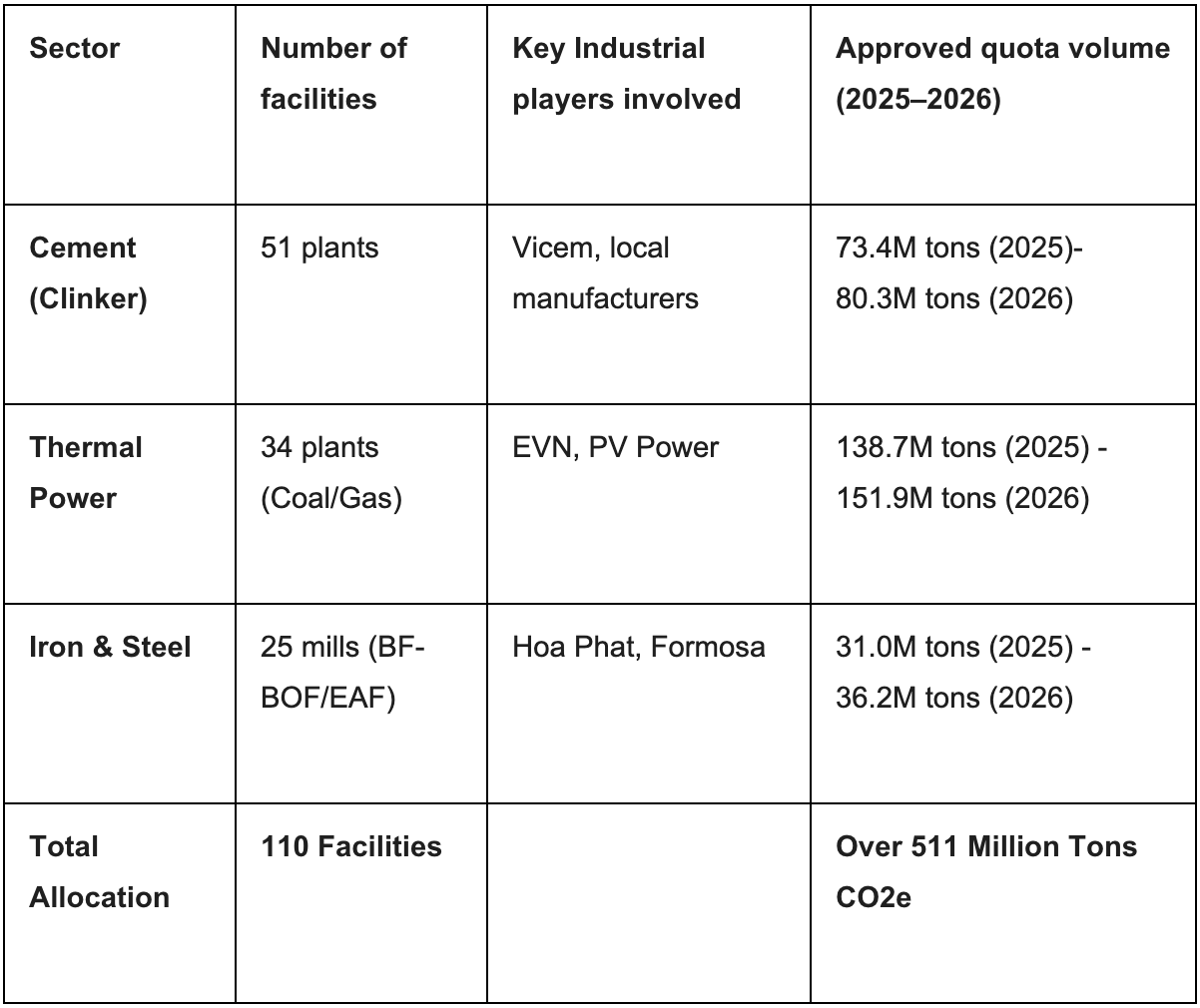
The 30% Offset Firewall: Preventing Market Loop-Holes
One of the most critical, highly technical aspects of Decree 29/2026/ND-CP is the 30% offset cap. Under a standard Cap-and-Trade model, companies exceeding their quota must acquire additional allowances. To prevent wealthy corporations from simply buying unlimited cheap carbon credits rather than actually cleaning up their factory operations, the Vietnamese government has built an intentional firewall: The 30% Rule: An enterprise facing a quota deficit can only cover a maximum of 30% of their total allocated allowance using verified external carbon credits. The remaining 70% of compliance must come from direct internal emission reductions or purchasing raw quotas (VN2025) from cleaner competitors on the HNX.
The Global Connection: Why This Matters for Exporters
The launch of the carbon platform is closely tied to international trade pressure, specifically the European Union’s Carbon Border Adjustment Mechanism (CBAM). If Vietnamese manufacturers export carbon-heavy goods (like steel or cement) to Europe without paying a carbon price domestically, they are hit with punitive carbon border taxes at the EU port of entry. By creating a verified domestic carbon market, the financial penalties are collected inside Vietnam. This keeps crucial climate revenue within national borders to fund local green infrastructure, rather than surrendering tax dollars to foreign treasuries.

A Legacy Built for Tomorrow
At its core, the carbon exchange is more than an ecosystem of symbols, ticker codes, and ledger sheets. It represents a legally binding commitment to protect our shared atmosphere. By assigning a transparent financial cost to pollution, Vietnam is paving a viable pathway to its Net-Zero 2050 targets - safeguarding natural ecosystems, stabilizing industrial supply chains, and ensuring a healthy, sustainable world for the generations to come.
#ESG #SustainableBusiness #CarbonCredit #BusinessGrowth #GHGProtocol#CarbonTrading