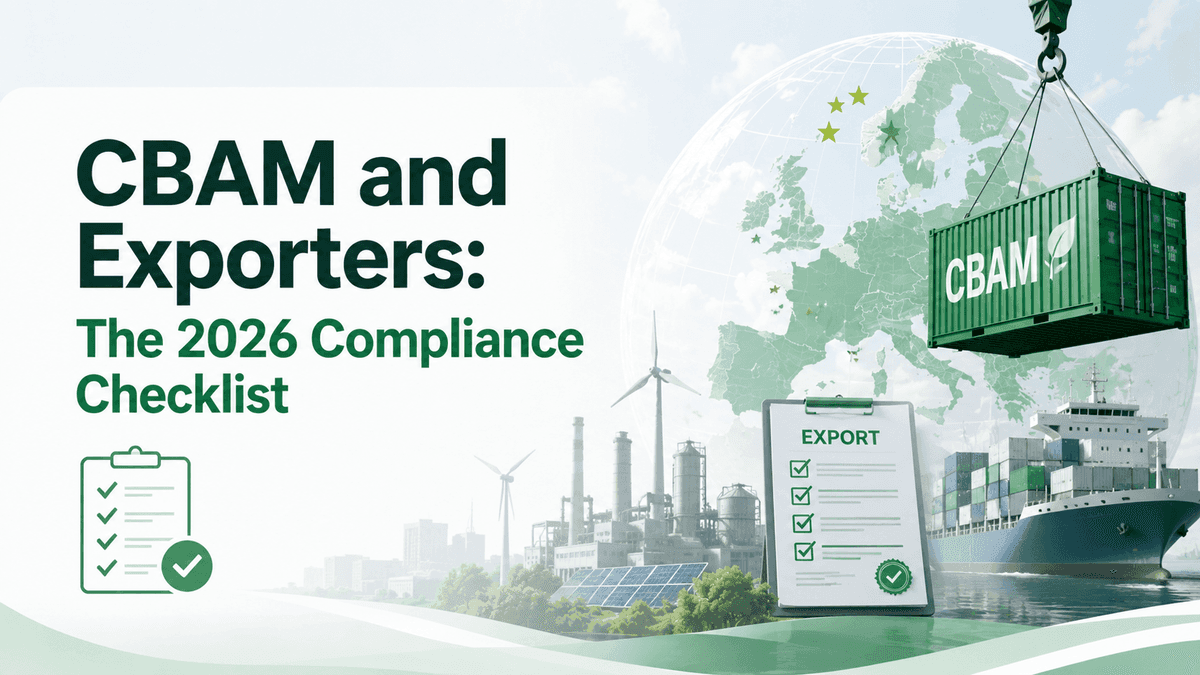
CBAM Has Moved Beyond Reporting and Into Market Access
Your EU buyer just sent a request for verified embedded emissions data. If you don’t have the system to respond, you are already behind. The Carbon Border Adjustment Mechanism (CBAM) is no longer operating as a distant policy signal. It is now reshaping procurement decisions, supplier qualification processes, and cost structures across global supply chains. The transition phase that began in October 2023 focused primarily on emissions reporting. That period allowed EU importers and non-EU producers to build data collection processes and understand reporting obligations. The next phase changes the equation. From 2026 onward, importers will need to purchase CBAM certificates tied to embedded emissions in imported products. Companies unable to provide credible emissions data face financial exposure, supplier replacement risk, and reduced competitiveness in European markets. For many exporters, the challenge is not simply regulatory interpretation. The real issue is operational readiness. Most companies still rely on fragmented spreadsheets, inconsistent emissions methodologies, and supplier-level estimates that cannot withstand verification requirements. CBAM is forcing businesses to treat carbon data with the same rigor as financial reporting.
Exporters Are No Longer Indirectly Affected by EU Climate Policy
Many manufacturers outside Europe initially assumed CBAM obligations applied only to EU importers. That assumption no longer reflects market reality. While the legal obligation to submit CBAM declarations sits with the authorized EU declarant, exporters are now expected to provide verified emissions data to customers on a recurring basis. The mechanism currently covers sectors considered highly carbon-intensive and trade-exposed. These include:
- Iron and steel
- Cement
- Aluminum
- Fertilizers
- Hydrogen
- Electricity
The European Commission has also signaled continued expansion of CBAM coverage over time, particularly as reporting infrastructure matures and emissions accounting becomes more standardized. For exporters in Vietnam and ASEAN, this creates a structural supply chain issue. European buyers increasingly require emissions transparency not only from direct suppliers but also across upstream production networks. Manufacturers without auditable emissions data are becoming procurement risks. In 2024 alone, Vietnam exported more than 12.6 million tonnes of steel globally with a total export value of approximately USD 9.08 billion. The EU remains one of the largest destinations for Vietnamese steel products, particularly coated steel, HRC, CRC, pipes, and industrial construction materials. This is especially visible in steel, aluminum, and industrial manufacturing sectors where buyers are beginning to compare suppliers based on carbon intensity alongside price, delivery, and quality metrics.
The 2026 Shift Changes What “Compliance” Actually Means
The reporting-only transition period allowed companies to use default values and simplified methodologies in many situations. Beginning in 2026, expectations become significantly stricter. What the EU buyers must do:
- Register as authorized CBAM declarants
- Submit annual CBAM declarations
- Report verified embedded emissions
- Purchase CBAM certificates corresponding to emissions exposure
- Maintain auditable emissions records This changes the role of non-EU exporters. EU exporters must now produce emissions data that aligns with EU-approved methodologies and withstands third-party verification scrutiny. Default emissions values become commercially dangerous because they often result in higher calculated carbon exposure. The cost implication is direct. If actual emissions data is unavailable or unreliable, importers may rely on conservative assumptions that increase CBAM certificate costs. Those costs ultimately flow back into supplier negotiations, margin pressure, or sourcing decisions. Several industry analyses in 2025 and early 2026 highlighted a growing divide between exporters with operational carbon accounting systems and those still treating emissions reporting as an annual sustainability task. Companies in the second category are increasingly struggling with customer requests, data traceability demands, and verification timelines.
Most Exporters Underestimate the Scope of Data Required
CBAM reporting is not limited to final emissions totals. The regulation requires detailed emissions accounting methodologies tied to production processes, energy consumption, and production boundaries.
For many exporters, the operational gap appears in four areas.
- First, facility-level activity data is often incomplete or inconsistent across sites. Energy invoices, fuel consumption records, production volumes, and process emissions are frequently managed by separate departments with no unified reporting structure.
- Second, emissions methodologies are not standardized internally. Different plants may use different emission factors, assumptions, or calculation methods. This creates comparability problems and increases verification risk.
- Third, supplier-level data collection remains weak. Many companies can estimate Scope 1 and Scope 2 emissions internally but lack visibility into upstream material emissions that affect product-level calculations.
- Fourth, audit trails are missing. Even when companies can produce emissions figures, they often cannot demonstrate how those figures were generated, validated, or approved. CBAM exposes these operational weaknesses quickly because reporting timelines are recurring and data requests become increasingly granular over time.
The Companies Moving Faster Are Treating Carbon Data Like Financial Data
The exporters responding effectively to CBAM are not building isolated sustainability reports. They are establishing emissions data infrastructure. This distinction matters because CBAM is fundamentally a data governance challenge. Companies need systems capable of collecting, validating, storing, and updating emissions information continuously across multiple business units and production facilities. The operational model increasingly resembles financial reporting systems:
- Defined ownership of data inputs
- Standardized calculation methodologies
- Approval workflows
- Centralized reporting structures
- Version control and audit history
- Verification-ready documentation Companies that already operate this way are shortening verification timelines by weeks. This shift is also changing internal organizational structures. Sustainability teams alone cannot manage CBAM readiness. Operations, procurement, finance, compliance, and production teams now play active roles in emissions management. For industrial exporters, carbon accounting is becoming embedded into operational decision-making rather than remaining a separate ESG function.
Your 2026 CBAM Compliance Checklist Starts With Operational Readiness
Most companies do not fail CBAM because they misunderstand the regulation. They fail because their internal systems cannot consistently produce credible emissions data at scale. For companies still in early-stage readiness, the first priority is mapping reporting boundaries and identifying affected products. This means determining which exported goods fall under CBAM coverage, which production facilities contribute to those products, and which emissions sources must be included in calculations. At this stage, businesses should also assess current data availability. Many companies discover that required production or energy data either does not exist in structured form or is managed manually across disconnected teams. For companies already producing ESG or carbon reports, the focus shifts toward methodology alignment and verification readiness. Existing sustainability reporting processes often rely on annual estimates or aggregated figures unsuitable for CBAM reporting requirements. Organizations in this category should review:
- Emissions calculation methodologies
- Facility-level data granularity
- Production allocation logic
- Emission factor sources
- Documentation quality
- Internal approval processes The goal is not simply producing emissions numbers. The goal is producing numbers that EU importers and verifiers can defend during regulatory review. For mature exporters supplying large EU customers, the next step is operational integration. Carbon reporting must connect directly into procurement, production planning, and customer reporting workflows. This increasingly includes:
- Product Carbon Footprint (PCF) calculations
- Batch-level emissions tracking
- Automated reporting systems
- Supplier emissions onboarding
- Real-time monitoring dashboards
- Carbon intensity benchmarking The market is moving toward continuous carbon visibility rather than periodic sustainability disclosure.
Verification Will Become One of the Biggest Bottlenecks
Many exporters are focused primarily on emissions calculations while underestimating the complexity of verification requirements. From 2026 onward, embedded emissions data associated with CBAM declarations must undergo independent verification according to EU requirements. This creates pressure on both internal documentation quality and external assurance capacity. Verification failures can create commercial delays for importers, especially when emissions data is incomplete, inconsistent, or unsupported by traceable records. Several operational problems are already emerging in pilot implementations and transition reporting exercises:
- Missing production allocation documentation
- Unclear emissions boundaries
- Inconsistent treatment of purchased electricity
- Supplier data gaps
- Unsupported assumptions
- Spreadsheet calculation errors
- Lack of version control These are not theoretical risks. They directly affect whether EU importers can confidently submit declarations and calculate CBAM liabilities. As verification demand rises across global supply chains, companies without structured emissions management systems may face increasing delays and compliance costs.
CBAM Is Accelerating the Shift Toward Product-Level Carbon Accounting
One of the most important long-term implications of CBAM is the movement toward product-level emissions transparency. Historically, many ESG programs focused on organization-wide emissions reporting. CBAM changes the emphasis toward embedded emissions associated with specific goods. This creates pressure for exporters to calculate carbon intensity at a much more detailed level. For manufacturers, this may involve:
- Tracking emissions by production line
- Allocating emissions by batch or product category
- Connecting ERP and operational data into carbon calculations
- Linking supplier materials to product footprints
- Monitoring emissions performance over time The companies building these capabilities early are likely to gain advantages beyond compliance. European buyers increasingly view verified low-carbon products as procurement differentiators. Financial institutions are also beginning to assess transition risk exposure at the sector and supplier level. Over time, carbon transparency is expected to influence financing access, procurement eligibility, insurance assessments, and export competitiveness. CBAM is not creating this transition alone. It is accelerating trends already emerging through IFRS S2 climate disclosure expectations, Scope 3 supply chain reporting, and industrial decarbonization targets.
Exporters Need Systems, Not More Manual Reporting Work
Many businesses initially responded to CBAM by increasing manual reporting efforts. That approach may work temporarily during pilot phases or limited reporting cycles, but it does not scale operationally. As reporting frequency increases and verification expectations tighten, manual workflows become major business risks. Spreadsheets create version control problems. Email-based approvals create audit trail gaps. Disconnected production and sustainability teams create data inconsistencies.
The operational direction is increasingly clear. Companies need centralized ESG and carbon data infrastructure capable of supporting:
- Multi-site emissions management
- Structured data collection
- Automated calculation logic
- Workflow approvals
- Verification support
- Dashboard analytics
- Report-ready outputs This is especially relevant for exporters managing multiple facilities, subsidiaries, or supplier networks. The companies that adapt fastest are treating ESG and carbon management as enterprise infrastructure rather than isolated compliance projects.
The Real Competitive Divide Will Be Data Credibility
CBAM is often framed as a carbon tax issue. In practice, the larger competitive divide may come from data credibility. European buyers are under growing pressure to demonstrate that imported goods meet emissions reporting requirements backed by defensible methodologies and verification processes. Suppliers unable to provide reliable emissions information risk becoming operational liabilities. Over the next several years, exporters will likely separate into three groups.
- The first group will continue relying on manual reporting and reactive customer responses. These companies may remain exposed to verification issues, procurement risk, and margin pressure.
- The second group will achieve baseline compliance but struggle with scalability as reporting demands expand across products, suppliers, and markets.
- The third group will establish integrated carbon management capabilities tied directly into operations and decision-making. These companies are more likely to position themselves as preferred suppliers in increasingly carbon-sensitive markets.
CBAM is not simply another sustainability disclosure requirement. It represents a structural shift in how industrial competitiveness is measured. Is your organization ready for the 2026 reporting shift? Our advisory team specializes in helping businesses transition from GRI to IFRS, build CBAM-ready reporting systems, and design multi-framework ESG strategies for exporters and listed companies in Vietnam. Get in touch to arrange a strategic ESG assessment today. #ESG #SustainableBusiness #CBAM #BusinessGrowth #GHGProtocol