Vietnam Data Center Market Enters a New Growth Phase
Vietnam’s data center market is entering a period of accelerated growth, driven by digital transformation, cloud adoption, and increasing demand for local data infrastructure. As businesses scale their digital operations and regulatory requirements encourage data localization, the role of data centers is becoming more central to the country’s economic development. Electricity demand from data centers is projected to reach approximately 242 MW by 2029, growing at a compound annual growth rate (CAGR) of around 7.38%. At the same time, national development plans indicate that Vietnam could have around 24 data centers with a combined capacity of roughly 560 MW by 2030. These figures reflect not only market expansion, but also the strategic importance of digital infrastructure in supporting long-term economic growth. This growth, however, is no longer defined purely by capacity. As the market matures, the criteria for what constitutes a “qualified” data center are becoming more structured and demanding.
A New Threshold Is Emerging: Efficiency as a Requirement
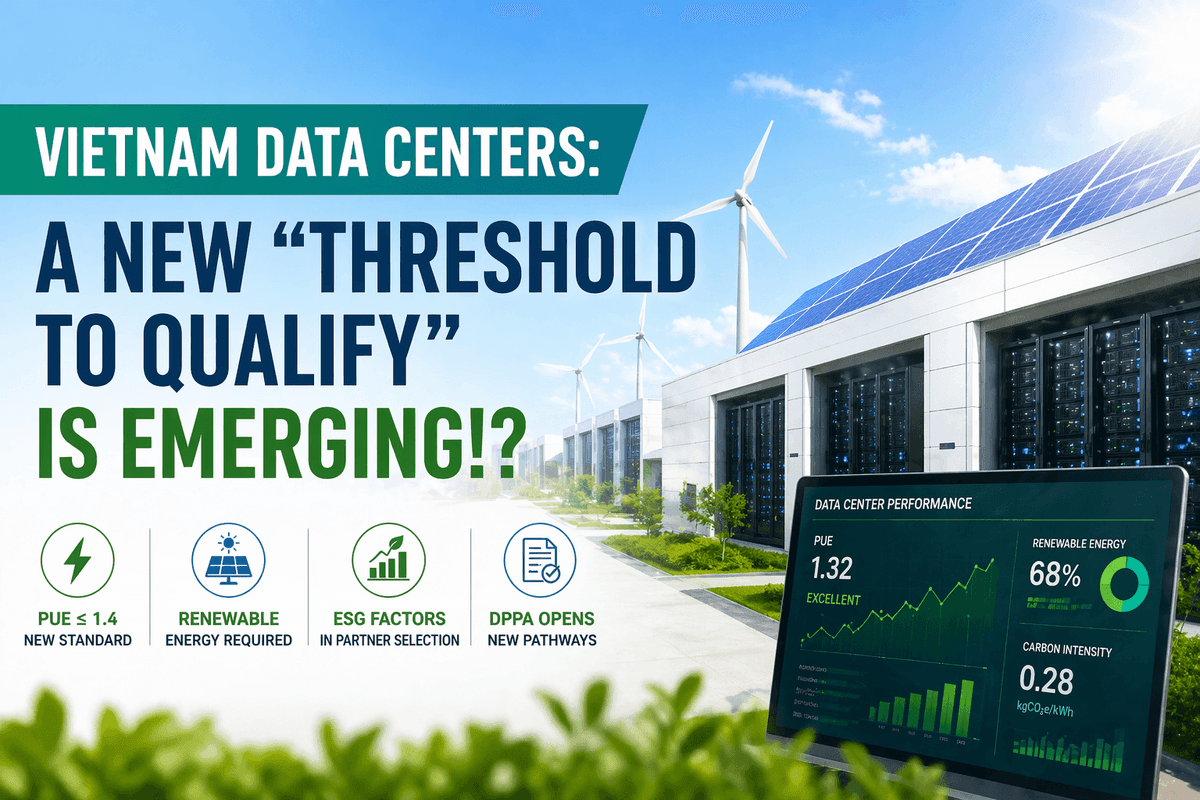
The data center industry in Vietnam is gradually shifting from expansion-focused growth to efficiency-driven competition. While capacity and uptime remain critical, energy performance is becoming a defining factor in how data centers are evaluated by regulators, investors, and clients. An upcoming Data Centre Decree is expected to introduce more specific operational requirements, including clear benchmarks for energy efficiency. Among these, Power Usage Effectiveness (PUE) is emerging as a central metric. This shift signals a broader change. Efficiency is no longer a technical optimization handled internally by operators. It is becoming a requirement that influences compliance, market access, and long-term viability. As expectations become more defined, data centers will need to demonstrate not only that they can operate reliably, but also that they can operate efficiently under increasingly transparent conditions.
PUE: From Benchmark to Qualification Criteria
PUE has long been used as a measure of energy efficiency in data centers, indicating how effectively total facility energy is used relative to IT equipment energy. A lower PUE reflects better efficiency. In Vietnam, the anticipated threshold of PUE ≤ 1,4 represents a meaningful benchmark. While not yet universally enforced, it signals the direction in which regulatory expectations are moving. This threshold changes how data centers approach design and operations. Achieving a PUE of 1,4 or below requires careful planning across cooling systems, power distribution, and facility management. It also requires continuous monitoring and optimization rather than one-time configuration. More importantly, PUE is becoming part of how data centers are evaluated externally. It is no longer just an internal KPI. It is increasingly a visible indicator of whether a facility meets emerging standards. As a result, PUE is evolving from a performance metric into a qualification criterion.
Renewable Energy Is Becoming a Market Entry Condition
Alongside efficiency requirements, renewable energy is becoming a central factor in data center operations. Global cloud providers such as Amazon Web Services (AWS), Google Cloud, and Microsoft Azure are increasingly requiring their infrastructure partners to use renewable energy. This reflects broader commitments to decarbonization and sustainability across global technology ecosystems. In practice, this means that access to renewable energy is no longer optional for data centers that aim to serve international clients. It is becoming a condition for participation in global infrastructure networks. Beyond hyperscalers, sustainability considerations are also influencing how enterprises select data center partners. “Green” factors, including renewable energy usage and carbon footprint transparency, are becoming part of procurement and partnership decisions. This introduces a new layer of competition. Data centers are not only competing on price and performance, but also on their ability to demonstrate sustainable operations.
The Operational Gap: Where Most Data Centers Stand Today
Despite clear direction from both market and policy, many data centers in Vietnam are still building foundational capabilities in energy management and sustainability. Monitoring and optimizing energy performance remains a work in progress for many operators. While some facilities have advanced systems in place, others rely on fragmented data collection and limited real-time visibility. This makes it difficult to consistently track PUE, identify inefficiencies, and implement improvements. Securing renewable energy is another challenge. Even as demand increases, access to stable and traceable renewable energy sources is not always straightforward. Data centers need to ensure that energy supply is not only available, but also verifiable and aligned with client requirements. At the same time, ESG reporting capabilities are still developing. As clients and regulators require more structured and auditable data, data centers must build systems that can collect, validate, and report information across multiple dimensions. These gaps do not indicate a lack of progress. They reflect the complexity of transitioning from traditional infrastructure operations to more integrated, data-driven energy systems.
Policy Tailwinds: DPPA and Investment Openness
Policy developments in Vietnam are creating additional pathways for data centers to address these challenges. The Direct Power Purchase Agreement (DPPA) mechanism allows companies to procure renewable energy directly from producers. This creates opportunities for data centers to secure long-term, stable energy supply that aligns with sustainability requirements. At the same time, increasing openness to foreign investment is supporting the development of more advanced infrastructure. International operators bring experience in energy optimization, renewable integration, and ESG reporting, contributing to the overall maturity of the market. These policy shifts do not remove operational challenges, but they provide tools that data centers can use to build more robust energy strategies. The ability to leverage these tools effectively will become a key differentiator.
What Will Define Competitive Data Centers in Vietnam
As the market evolves, the definition of a competitive data center is changing. Capacity and uptime remain essential, but they are no longer sufficient on their own. Data centers must demonstrate efficiency, sustainability, and the ability to operate within increasingly structured frameworks. This includes achieving and maintaining low PUE levels, integrating renewable energy into operations, and building systems that support transparent and reliable ESG reporting. More fundamentally, it requires a shift toward system-level thinking. Energy management can no longer be treated as a set of isolated activities. It must be integrated into a cohesive system that connects data, operations, and decision-making. Data centers that invest early in these capabilities will be better positioned to meet regulatory requirements, attract global clients, and adapt to future changes. Those that delay may find themselves constrained by systems that were not designed for this level of complexity.
Conclusion
Vietnam’s data center market is expanding rapidly, supported by strong demand and favorable policy conditions. At the same time, a new qualification threshold is emerging, defined by energy efficiency, renewable integration, and ESG performance. The shift is subtle but significant. The question is no longer whether data centers can be built. It is whether they can meet the evolving standards required to operate at scale. Efficiency is becoming a requirement. Renewable energy is becoming a condition. Data systems are becoming essential. The next phase of growth will be shaped not only by how much capacity is added, but by how effectively that capacity is managed.
The threshold is rising - the market is adjusting.
Follow us for more insights on Data Centers, efficiency standards, and ESG implementation in Vietnam. #VietnamDataCenter #PUE #ESG #DigitalInfrastructure #Efficiency #VietnamTech