The Shift Toward Energy Management in Vietnam Industrial Parks
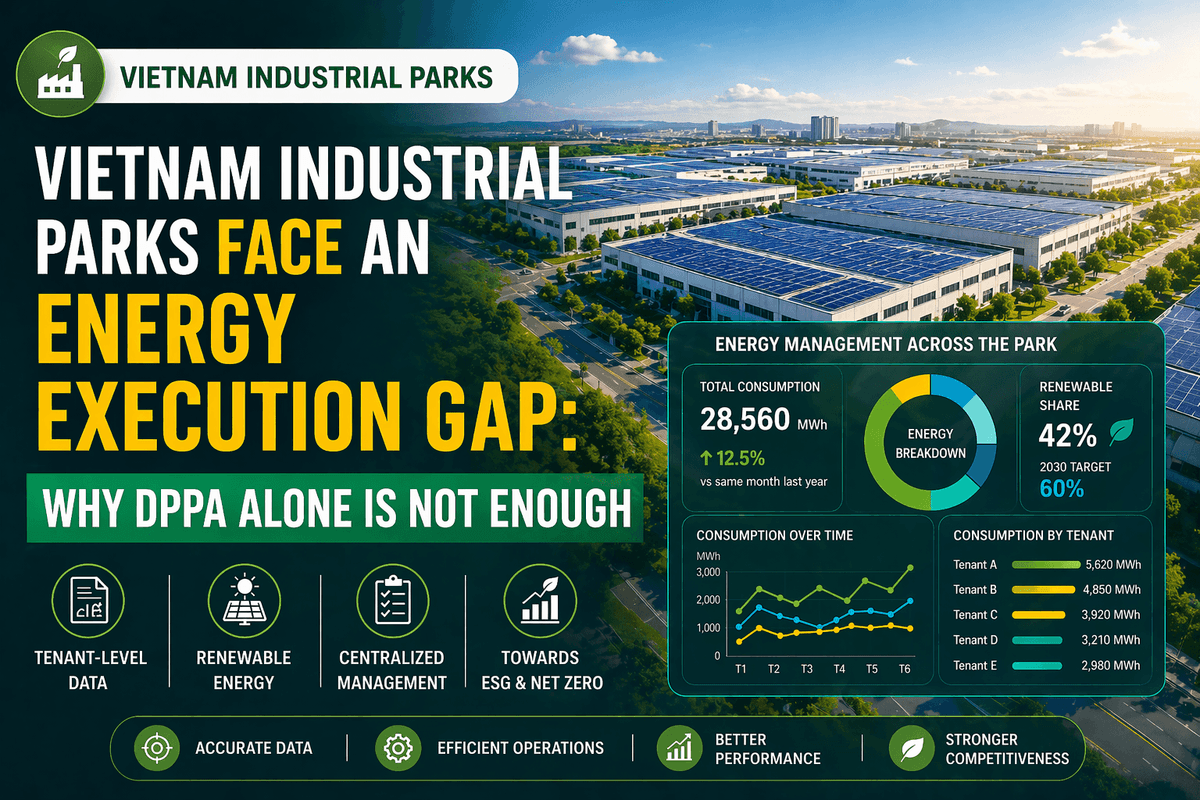
Vietnam industrial parks are entering a new phase of the energy transition, where expectations are no longer limited to infrastructure development or basic utility provision. Energy management is becoming a core operational requirement, shaped by regulation, market demand, and global supply chain pressure. Recent regulatory developments require industrial park developers to improve electricity efficiency and integrate energy-related metrics into operations. This marks a clear shift. Energy is no longer a background utility. It is becoming part of how industrial parks measure performance, manage tenants, and respond to compliance requirements. At the same time, Resolution 253/2025/QH15 enables industrial parks to procure renewable energy through the Direct Power Purchase Agreement (DPPA) mechanism and redistribute that energy to tenants. This introduces a new layer of responsibility. Industrial park operators are no longer just infrastructure providers. They are expected to coordinate energy across multiple tenants in a structured way. This transition creates both opportunity and complexity, especially for parks that have not yet built the systems required to manage energy at scale.
DPPA in Vietnam: Opportunity Without Execution Systems
The introduction of DPPA in Vietnam is widely seen as a major step forward for renewable energy adoption. It allows industrial parks to access cleaner electricity directly from producers, creating a pathway for large-scale energy transition within manufacturing ecosystems. However, access alone does not guarantee execution. Once renewable energy is procured, industrial parks must allocate it across tenants, track consumption against contracted volumes, and manage fluctuations in demand. These processes require continuous coordination rather than one-time implementation. Without a centralized system, DPPA becomes difficult to scale. Industrial parks may be able to execute individual agreements, but struggle to apply the same model across dozens or hundreds of tenants with different consumption patterns. The challenge is not the availability of renewable energy. It is the absence of systems that can operationalize it.
Why Tenant-Level Energy Data Is the Real Bottleneck
The biggest constraint in energy management within Vietnam industrial parks is not infrastructure, but visibility. Most industrial parks do not have a standardized way to track tenant-level energy consumption. In practice, data is often fragmented. Some tenants report periodically, others use separate systems, and much of the information is handled manually. This creates inconsistencies that make it difficult to build a complete and reliable picture of energy usage. The impact of this limitation is significant. Renewable energy allocation becomes difficult when consumption is not clearly understood. Tracking becomes reactive instead of proactive. Reporting becomes more complex as regulatory requirements demand higher levels of transparency and auditability. For example, an industrial park may procure renewable energy through DPPA, but without accurate tenant-level data, it cannot determine how to distribute that energy effectively. Over time, this leads to inefficiencies, underutilization, and potential disputes between stakeholders. What starts as a data issue evolves into a structural limitation. Without visibility, industrial parks cannot move toward scalable energy management.
Renewable Energy in Industrial Parks: Supply Is Not the Issue
Vietnam has already demonstrated strong growth in renewable energy within industrial parks. Rooftop solar capacity has exceeded 3,200 MWp, with total potential estimated to surpass 40,000 MWp. These figures highlight the scale of opportunity available.
This changes the narrative around energy transition. The primary constraint is no longer supply. Industrial parks have access to renewable energy and the technical potential to expand further. The focus now shifts toward how that energy is managed. Generating more renewable electricity does not automatically improve efficiency or compliance if there is no system to allocate and track it effectively. The bottleneck moves from infrastructure to coordination. Industrial parks need to manage energy flows, not just energy sources.
The Gap Between Regulation and Operational Readiness
As regulatory expectations increase, the gap between policy and operational capability becomes more visible. Industrial parks are expected to provide structured energy data, support renewable integration, and improve efficiency across tenants. Many are still operating with fragmented processes and limited system integration. This creates challenges in both compliance and competitiveness. From a regulatory perspective, the lack of standardized data makes it difficult to meet reporting requirements. From a market perspective, it limits the ability to attract tenants that require reliable energy data and access to renewable sources. Global manufacturers, particularly those in export-driven industries, are under increasing pressure to track and disclose energy usage. They prefer industrial parks that can support these requirements in a structured and scalable way. Industrial parks that cannot provide this level of capability risk falling behind, not because of policy constraints, but because of operational limitations.
How Industrial Parks Can Close the Energy Execution Gap
Closing the energy execution gap requires more than incremental improvements. It requires a shift toward system-level thinking. Industrial parks need centralized platforms that can collect, validate, and manage energy data across all tenants. They need visibility into consumption patterns at a granular level, allowing for accurate allocation and performance tracking. They also need workflows that connect tenants, operators, and reporting requirements into a single system. This is where digital energy management systems become critical. Without them, industrial parks remain dependent on manual processes that cannot scale with increasing complexity. The parks that move early in this direction will be better positioned to leverage DPPA, meet regulatory requirements, and attract high-quality tenants. Those that delay may find themselves constrained by systems that were not designed for this level of coordination.
Conclusion
Vietnam industrial parks are facing an energy execution gap. The policy environment is supportive, renewable energy supply is growing, and market expectations are increasing. Yet the systems required to manage energy at scale are still developing. The transition is no longer about whether industrial parks should adopt renewable energy. It is about whether they can operationalize it effectively. The next phase will be defined by execution capability. Industrial parks that can build visibility, coordination, and scalable systems will be the ones that lead the transition. The question is no longer whether this shift will happen. It is how quickly industrial parks can respond. Follow us for more insights on DPPA, energy management systems, and ESG implementation in Vietnam industrial parks. #VietnamIndustrialParks #DPPA #EnergyManagement #RenewableEnergy #ESG #VietnamEnergy #ForTheKids