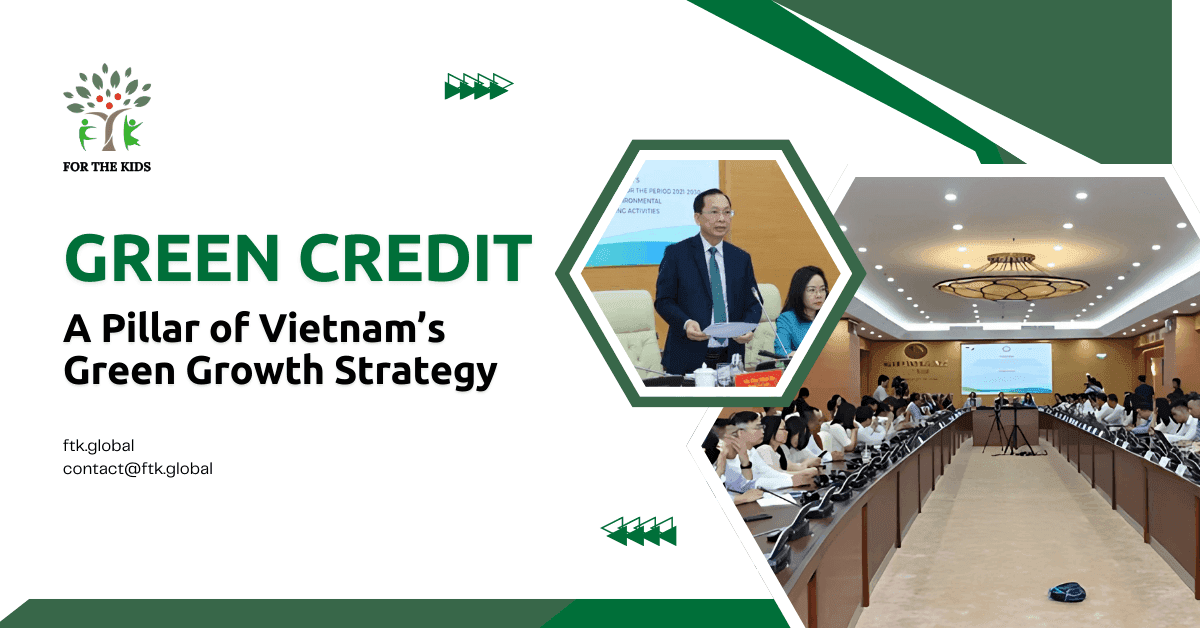
On May 21, 2025, at a high-level forum, Deputy Governor of the State Bank of Vietnam (SBV) Đào Minh Tú stated: “Green growth is no longer an option - it is an urgent requirement for developing countries like Vietnam.” Recognizing the vital role of the banking sector in implementing the National Green Growth Strategy, the SBV has, since 2015, integrated sustainability goals into credit policies, issuing directives to promote green credit and manage environmental–social risks in lending.
Thanks to this approach, Vietnam’s green credit has grown impressively, from VND 180 trillion (~USD 7.1 billion) in 2017 to over VND 704 trillion (~USD 28 billion) by March 2025. Green credit now accounts for about 4.3% of total outstanding loans, with an average annual growth rate of over 21% - far higher than the sector’s average. Fifty-seven credit institutions have assessed nearly 1.3 million loan applications for environmental-social factors, equivalent to VND 3.62 quadrillion (~USD 143 billion), 15 times higher than in 2017.
Several commercial banks have emerged as leaders in this field. BIDV has adopted ESG standards and developed a sustainable finance model with six strategic pillars; by the end of 2024, it had VND 80.87 trillion (~USD 3.2 billion) in green credit, accounting for 12% of the sector’s total, supporting nearly 2,000 green projects. Agribank has set up an ESG implementation committee, developed internal ESG standards, and raised its green credit ratio from 0.9% in 2020 to 1.7% in 2024. In Q1 2025, Agribank led the sector in customer numbers, serving over 41,600 green credit clients with outstanding loans of nearly VND 29.3 trillion (~USD 1.17 billion), focusing on renewable energy, clean energy, and sustainable forestry.
According to Michaela Baur, GIZ Country Director in Vietnam, a clear “green” classification system will ensure that funds are directed toward truly sustainable projects and improve Vietnam’s access to international green finance. Since 2017, GIZ has worked with the SBV to develop green credit statistics and a banking credit classification system. In the same spirit, MB Bank, represented by Nguyễn Minh Châu, has set the goal of becoming a leading green bank, fully integrating ESG and achieving carbon neutrality by 2030, while calling for more ESG training, knowledge-sharing, and incentive mechanisms from the SBV.
A key highlight of the forum was the launch of the Handbook on Environmental–Social Risk Management in Lending, jointly developed by SBV and IFC. This practical guide provides principles, risk management systems, performance indicators, and stakeholder engagement strategies based on international standards, enabling financial institutions to build effective green lending processes.
These developments create significant opportunities for FTK to partner with financial institutions in designing green credit products, delivering ESG training, developing ESG risk assessment tools aligned with international standards, and consulting on carbon neutrality roadmaps. Now is the perfect time for businesses and banks to take action and turn green credit into a true driver of Vietnam’s sustainable growth.
#GreenCredit #GreenGrowth #ESG #SustainableFinance #FTK #SustainableDevelopment #GreenBanking